Panacea Bio Chem
Binding affinity: how tightly two molecules bind — the science of molecular recognition
- Concept
- Binding affinity — how tightly two molecules hold together at equilibrium
- Primary metric
- Kd (equilibrium dissociation constant); lower value = tighter binding
- Related quantities
- Ki (inhibition), kon (association rate), koff (dissociation rate), residence time 1/koff
- Governing relation
- Kd = koff / kon
- Typical range
- millimolar (weak) → picomolar / femtomolar (very tight)
- Measured by
- SPR · BLI · ITC · MST · fluorescence titration
- Why it matters
- Precise, selective recognition underlies antibodies, aptamers, enzymes, sensors and designed peptide binders
- Reproducibility, measured
- ~14 % standard error across 22 operators on one shared protocol7; up to ~1000-fold discrepancy between published values where controls go unreported6
Binding affinity measures how tightly two molecules stay together once they meet. It is captured in a single number, the equilibrium dissociation constant Kd1: the smaller the Kd, the tighter the grip. Affinity is set by two rates — how fast partners lock on (kon) and how fast they let go (koff) — and it is read on instruments such as SPR, BLI and ITC. The ability to design molecules that recognise exactly one target, tightly and selectively, is one of the most useful powers in modern biochemistry: it makes precise medicines, clean diagnostics and exquisite sensors possible.
1What binding affinity is
Two molecules drifting through solution — a target and a binder such as an antibody, an aptamer or a designed peptide — are forever meeting and parting. Binding affinity is simply a measure of how strongly they prefer to be together rather than apart. When the fit between them is good, they spend most of their time bound; when it is poor, they barely associate at all. This preference is molecular recognition: the ability of one surface to pick out its partner from a crowded mixture of look-alikes.
Recognition comes from shape and chemistry complementarity. A binder presents a three-dimensional face whose contours, charges and hydrogen-bond partners match a patch on the target, the way a hand matches one specific glove. The better that match, the more of the two molecules' fleeting collisions end in a stable, held complex — and the higher the affinity. Nothing here is a matter of brute force; it is a matter of precise, cooperative fit.
2The numbers: Kd, Ki, kon and koff
When a binder meets its target, two things happen at once. Free molecules find each other and lock together at an association rate, kon (units M−1s−1), while bound pairs come apart again at a dissociation rate, koff (units s−1). At equilibrium the two flows balance, and their ratio defines the single most quoted number in molecular recognition:
Kd, the equilibrium dissociation constant, is given in molar units and reads backwards from intuition: a smaller Kd means a tighter bond. Numerically, Kd is the target concentration at which half of the binding sites are occupied. A micromolar binder (10−6 M) is loose; a nanomolar binder (10−9 M) is a thousand times tighter; the finest antibodies reach the picomolar range and beyond. Ki is the equivalent constant for an inhibitor competing for the same site, and lets different competitors be compared on one scale.
Because affinity is a ratio, two binders can share the same Kd yet behave nothing alike. One may snap on fast and fall off fast; another may find its target slowly but, once bound, refuse to let go. That second behaviour — a slow koff — gives a long residence time (1/koff), and a durable complex is exactly what a sensor, a diagnostic or a long-acting binder is often built to provide.
Definitions of Kd are everywhere; arithmetic with it is rarer, and it is the arithmetic that makes the point. Take two binders against one target.
Both are 1 nM binders. An affinity table would list them as equivalent. But binder A finds its target a hundred times faster and lets go a hundred times sooner, and their complexes last seventeen minutes and twenty-eight hours respectively. If the job is a rapid diagnostic capture step, A is the better molecule. If the job is to occupy a target between doses, B is — and no Kd comparison would ever have told you.
3How binding affinity is measured
Affinity is measured, not guessed. Modern biophysics offers a toolkit that watches molecules bind in real time or reads the heat and light of the event. Each method reports the same underlying story from a different angle — some give the full kinetics (kon and koff separately), others the equilibrium Kd and the thermodynamics behind it.
| Method | What it reads | Gives |
|---|---|---|
| SPR — surface plasmon resonance2 | Mass building up on a sensor surface as binding occurs, in real time | kon, koff, Kd |
| BLI — bio-layer interferometry | A shift in reflected light as a layer thickens with bound molecules | kon, koff, Kd |
| ITC — isothermal titration calorimetry3 | The tiny heat released or absorbed as partners bind in solution | Kd, ΔH, stoichiometry |
| MST — microscale thermophoresis | How binding changes a molecule's movement along a temperature gradient | Kd in solution |
| Fluorescence / equilibrium titration | A signal change as more target is titrated in | Kd |
Label-free real-time methods such as SPR and BLI are prized because they separate the on-rate from the off-rate — the difference between a fleeting handshake and a durable grip that a lone equilibrium figure would hide. ITC is valued because it works in free solution with no surface or tag and also reveals why a pairing is favourable: the balance of enthalpy and entropy behind the number.
How much of the disagreement between laboratories is the instrument? Less than instinct suggests. When 22 operators measured one antibody–antigen pair from shared reagents and one written protocol, the standard error in the rate constants was about ~14 % and the consensus constant came out KD 1.1 ± 0.2 nM7. Set against that, a review of 100 published RNA–protein binding studies found the controls that make a Kd judgeable usually undocumented, with literature discrepancies reaching ~1000-fold6. The dominant variable is the protocol and what gets written down about it — not the machine.
4Why it matters: designing precise, high-affinity binders
The real power of binding affinity is that it can be designed and improved on purpose. Nature already does this: the immune system runs affinity maturation4, iteratively refining an antibody's binding surface until it grips its target thousands of times more tightly than the first version did. Laboratories now do the same by design — engineering antibodies, aptamers and peptide binders, then screening and evolving them toward higher affinity and sharper selectivity.
Two properties make a binder genuinely useful, and both flow from affinity. Tightness (a low Kd) means a small amount of binder does the job and holds it. Selectivity means the binder engages its intended target and politely ignores the thousands of near-relatives around it — the quality that lets a medicine act where it should and a diagnostic light up only for the right molecule. Precise molecular recognition is, in this sense, one of biology's most constructive tricks: it is how cells route signals, how enzymes pick their substrates, and how a well-made binder turns a complex mixture into a clean, specific readout.
5Record hook: the tightest grip in nature
The story that makes affinity vivid is a partnership between a protein and a vitamin. Streptavidin, a protein from a soil bacterium, binds biotin (vitamin B7) with a Kd of roughly 10−14 M — femtomolar — making it among the strongest known non-covalent interactions in all of biology5. Once biotin settles into the streptavidin pocket, a lid of protein loops folds over it and a network of hydrogen bonds locks it in; the pair can stay together for days. That single, almost unbreakable, yet fully specific grip is so useful that it has become a universal fastener of biotechnology — used to anchor, capture and detect molecules across countless assays. It is the clearest demonstration of the whole idea: affinity is a superpower when it is both tight and exact.

6Where Panacea Bio Chem works: affinity that has to survive
Panacea Bio Chem designs custom peptides, and treats binding affinity as a property to be both built and protected. Ongoing work explores the design and screening of high-affinity, selective peptide binders — shaping a sequence so its binding-competent surface is presented cleanly to a single target — and, just as importantly, the direction its research points is keeping that affinity intact from the synthesiser to the point of use.
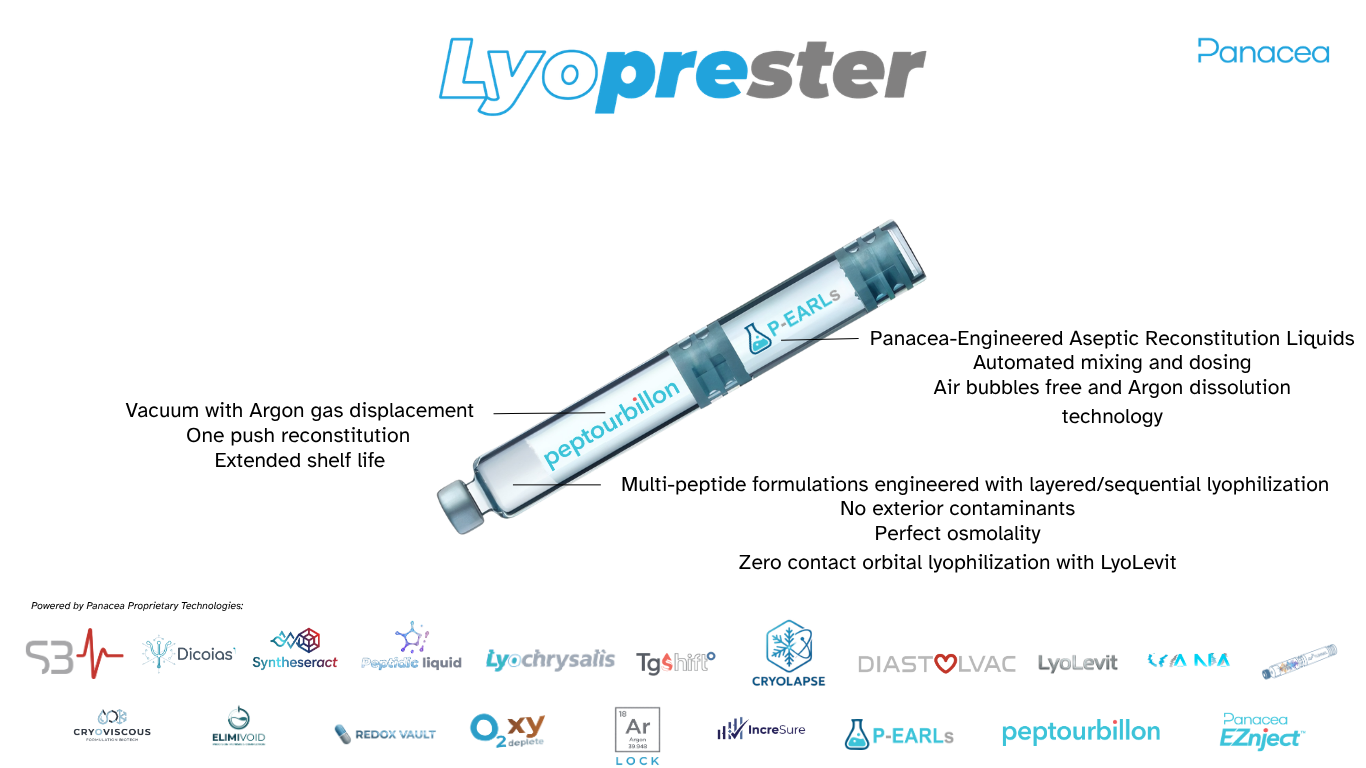
The design side is guided by Dicoias Ψ, the computed-chemistry advisory that reduces a substance to a vector across physical, electronic and formulation space. The holding side is where the rest of the chain does its work: OxyDeplete™ degassing and no-headspace doctrine and the final inert lock of ArgonLock™ keep oxygen away from the residues most likely to be oxidised; TgShift™ addresses the glass state the dried cake is held in; and the peptide is presented in the Lyoprester® dual-chamber cartridge, where the diluent is already aboard, the cake is never exposed to a room, and reconstitution is an actuation rather than a manual step. Each of these is a proprietary Panacea Bio Chem Ltd technology developed and invented by Bogdan Dicoias; their parameters and compositions are not publicly disclosed.
A binder is only as good as the shape it arrives in. A molecule engineered to grip tightly can lose that grip not because its sequence changed but because drying, storage or oxidation quietly reworked the delicate fold that made recognition possible. Panacea's angle joins the two halves of the problem — designing for high affinity, then preserving the binding-competent conformation through freeze-drying and shelf life — using its proprietary gentle-lyophilisation work →, inert-atmosphere sealing via RedoxVault →, and glass-state stabilisation explored through TgShift →. The precise sequences, screening cascades, parameters and hardware behind this remain a Panacea Bio Chem secret held by Bogdan Dicoias — the outline is here; the recipe stays behind the door.
7Application fields — where tight, selective binding helps most
- Precision medicines — antibodies and peptide binders that engage one target and spare its near-relatives, so a small dose acts exactly where intended.
- Diagnostics & biosensors — capture reagents whose tight, specific grip turns a messy sample into a clean, unambiguous signal.
- Long-acting biologics — binders tuned for a slow off-rate and long residence time, so a single molecule keeps working longer.
- Targeted delivery — homing peptides and aptamers that recognise a specific cell surface and carry a payload only to it.
- Purification & capture — affinity tags (the streptavidin–biotin family) that isolate one molecule cleanly from thousands of others.
- Portable, cold-chain-free reagents — the frontier where a high-affinity binder is designed and preserved so it still recognises its target after travelling warm.
Limits of this record
- A correction, on the record. An earlier version of this page cited PubMed 17406594 for isothermal titration calorimetry. That identifier is a paper on solid-phase extraction of N-linked glycopeptides — a different subject entirely. The intended reference was almost certainly PubMed 17406231, which is the calorimetry protocol now cited at reference 3. Both are Nature Protocols papers with adjacent identifiers, which is exactly why the error survived: a check that confirms the journal and the era passes it, and only reading the title and the author list catches it. Corrected 6 September 2026.
- No original measurements are reported here. Every number on this page comes from the cited literature. Panacea Bio Chem's own work is described as the direction of its research, and no result, trial or outcome is asserted.

Frequently asked
What is binding affinity?
Binding affinity is how tightly two
molecules hold together once they meet. It is summarised by the equilibrium
dissociation constant Kd — the smaller the Kd,
the tighter the binding. Kd equals the concentration at which half the
binding sites are occupied.
What is the difference between Kd, Ki,
kon and koff?
kon is how fast partners
lock together and koff is how fast they let go; their ratio,
Kd = koff/kon, is the equilibrium
affinity. Ki is the same idea for a competing inhibitor. Residence
time, 1/koff, is how long a complex lasts once formed.
How is binding affinity measured?
Label-free real-time methods such
as surface plasmon resonance (SPR) and bio-layer interferometry (BLI) follow
binding as it happens to read kon, koff and Kd;
isothermal titration calorimetry (ITC) measures the heat of binding in free
solution to give Kd and thermodynamics.
What is the tightest known binding affinity?
The
streptavidin–biotin pair, at a Kd near
10−14 M (femtomolar), is among the strongest known
non-covalent interactions in nature — and is used throughout biotechnology
precisely because it is so specific and durable.
Trending in the field
Recent developments in the field — refreshed 2026-10-03 by Panacea Bio Chem.
- Design, Synthesis and Biophysical Characterisation of CPP-PNA Conjugates for Targeting Oncogenic microRNA-221 — PubMed, 2026 Nov
- Combination of Polymeric Microneedles with Specific Peptide for TNF‑α Sensing Via Noninvasive Detection in Interstitial Fluid — PubMed, 2026 Sep 29
- An IgG-like fusion protein comprising an anti-spike S2 antibody and ACE2 exhibits potent and broad neutralization against SARS-CoV-2 and variants of concern — PubMed, 2026 Oct
- Targeting VISTA as a novel immunotherapy for skin cancer — PubMed, 2026
References & further reading
- Dissociation constant (Kd) and binding equilibria. Wikipedia.
- Surface plasmon resonance for affinity and kinetics. Wikipedia.
- Velazquez-Campoy A, Freire E. Isothermal titration calorimetry to determine association constants for high-affinity ligands. Nat Protoc 2006;1(1):186-91. PubMed.
- Affinity maturation of antibodies. Wikipedia.
- The streptavidin–biotin interaction — one of the strongest non-covalent bonds. PubMed · Wikipedia.
- Jarmoskaite I, AlSadhan I, Vaidyanathan PP, Herschlag D. How to measure and evaluate binding affinities. eLife 2020;9:e57264. PubMed 32758356 · full text. Primary.
- Katsamba PS, Navratilova I, Calderon-Cacia M, et al. (Myszka DG). Kinetic analysis of a high-affinity antibody/antigen interaction performed by multiple Biacore users. Analytical Biochemistry 2006;352(2):208–21. PubMed 16564019. Primary.
- Hulme EC, Trevethick MA. Ligand binding assays at equilibrium: validation and interpretation. British Journal of Pharmacology 2010;161(6):1219–37. PubMed 20132208. Primary.
- Myszka DG. Improving biosensor analysis. Journal of Molecular Recognition 1999;12(5):279–84. PubMed 10556875. Primary.
- Vauquelin G, Charlton SJ. Exploring avidity: understanding the potential gains in functional affinity and target residence time of bivalent and heterobivalent ligands. British Journal of Pharmacology 2013;168(8):1771–85. PubMed 23330947. Primary.
- Copeland RA, Pompliano DL, Meek TD. Drug-target residence time and its implications for lead optimization. Nature Reviews Drug Discovery 2006;5(9):730–9. PubMed 16888652 — erratum Nat Rev Drug Discov 2007;6(3):249. Primary.
- Seidel SA, Dijkman PM, Lea WA, et al. Microscale thermophoresis quantifies biomolecular interactions under previously challenging conditions. Methods 2013;59(3):301–15. PubMed 23270813. Primary.
All nine primary identifiers above were fetched from NCBI and their author bylines, journals and titles checked against the claims they support on 6 September 2026. Background entries are general reading and are not the evidence for any specific figure on this page.